
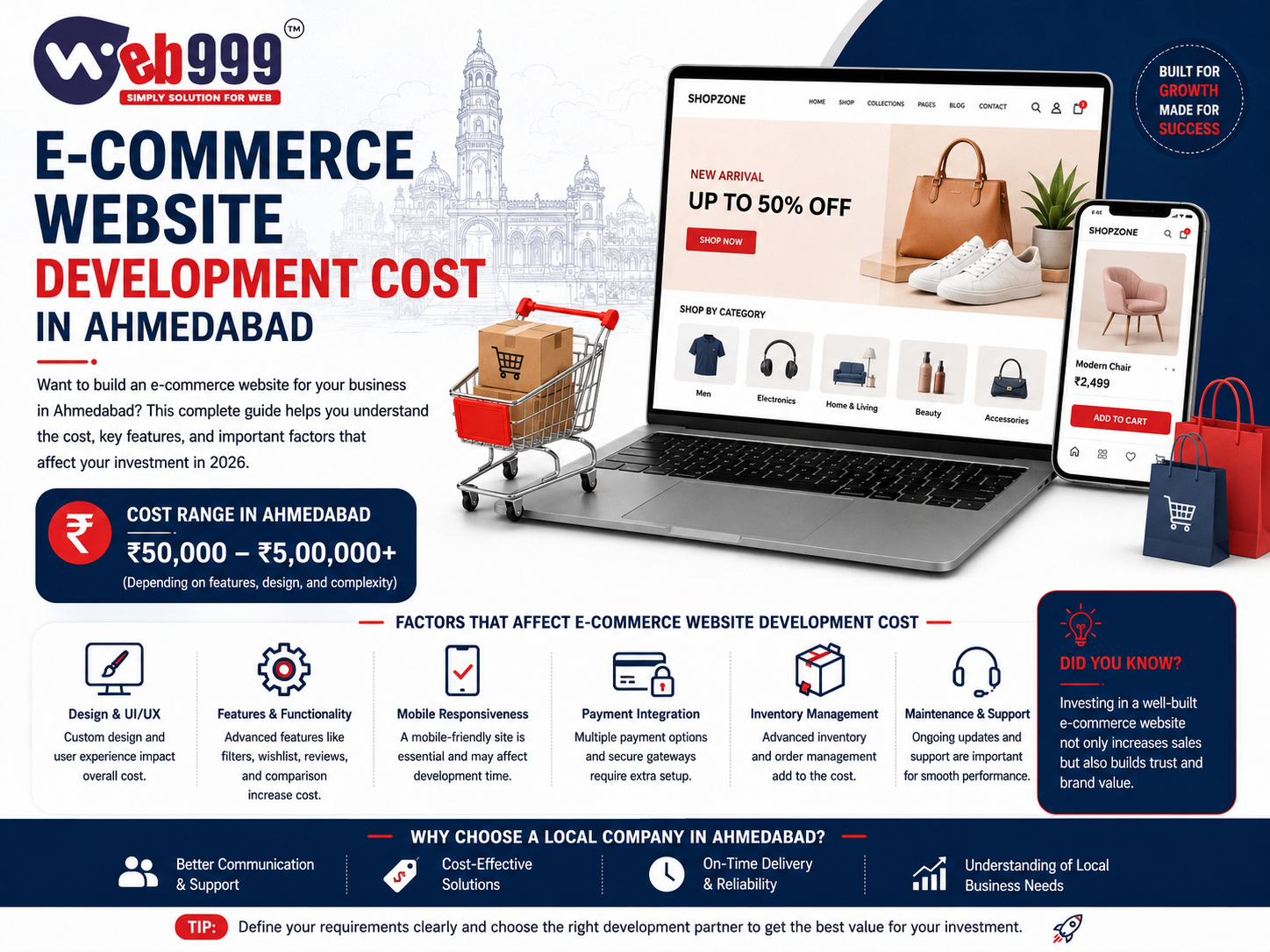
Planning to start selling your products online?
One of the first questions you will probably have is:
“How much does an e-commerce website cost in Ahmedabad?”
The short answer is that there is no single price.
A basic online store for a local business may cost around ₹25,000–₹40,000, while a larger e-commerce website with custom design, hundreds of products, advanced filters, shipping integrations and automation can cost ₹1 lakh or considerably more.
The price depends on what you want your online store to do.
If you’re trying to understand the e-commerce website development cost in Ahmedabad, this guide will help you understand where your money goes, which features you actually need and what to check before hiring a developer.
How Much Does an E-Commerce Website Cost in Ahmedabad?
For 2026, a practical starting point can look something like this:
| E-Commerce Website Type | Approximate Cost |
|---|---|
| Basic E-Commerce Website | ₹25,000 – ₹40,000 |
| Small Business Online Store | ₹30,000 – ₹60,000 |
| Professional E-Commerce Website | ₹60,000 – ₹1,50,000 |
| Advanced E-Commerce Website | ₹1,00,000 – ₹3,00,000+ |
| Custom E-Commerce Platform | ₹2,00,000+ |
| Multi-Vendor Marketplace | Based on Requirements |
These figures are only general estimates.
A website selling 30 products does not require the same development work as an online store managing 5,000 products.
Similarly, a business that only needs online payments and basic shipping will have a different budget from a company that needs ERP, CRM, warehouse or logistics integrations.
So instead of asking only:
“What is the price of an e-commerce website?”
ask:
“What features does my business actually need?”
That question will give you a much more realistic budget.
What Do You Get in a Basic E-Commerce Website?
Let’s take a small Ahmedabad business as an example.
Suppose you currently sell through your physical store, Instagram or WhatsApp and now want customers to place orders directly through your website.
You probably don’t need an extremely complicated system.
A basic e-commerce website can include:
- Professional homepage
- Product categories
- Individual product pages
- Product images
- Product pricing
- Add to Cart
- Shopping cart
- Checkout page
- Online payment gateway
- Cash on Delivery
- Customer details
- Order management
- WhatsApp integration
- Contact page
- Mobile-responsive design
For many local retailers and new online brands, this is enough to get started.
You can always add more features as your online business grows.
Web999 Basic E-Commerce Website Package
At Web999, our Basic Ecommerce package is designed for businesses that want to start selling products online without investing in an unnecessarily complicated platform.
The package is currently priced at:
₹29,999 / Project
It includes:
- WordPress + WooCommerce
- Up to 100 products upload
- Product categories setup
- Add / Edit / Delete product functionality
- Shopping cart
- Checkout system
- Payment gateway integration
- Cash on Delivery option
- Order management dashboard
- Mobile-responsive website
This type of setup can be suitable for local businesses, retailers, startups and product brands that want to move from offline or social-media selling to their own online store.
Instead of paying for features you may never use, you can start with the essentials and expand when your business needs them.
What Affects E-Commerce Website Development Cost?
Two e-commerce websites may look similar from the outside but have completely different development costs.
Here are the main factors that affect the final quotation.
1. Number of Products
This is one of the first things a developer will ask you.
How many products do you want to sell?
For example:
- 10–50 products: relatively simple setup
- 50–100 products: suitable for many small stores
- 100–500 products: requires more product and category management
- 1,000+ products: may require advanced import, filtering and inventory systems
Uploading products also takes time.
Each product may require:
- Product name
- Description
- Price
- Images
- SKU
- Category
- Stock
- Variations
- Specifications
If your developer has to manually prepare and upload hundreds of products, expect the development cost to increase.
2. Simple Products vs Product Variations
Not every product is simple.
Imagine you’re selling a T-shirt.
The same T-shirt may have:
- Sizes: S, M, L, XL, XXL
- Colours: Black, White, Blue, Red
That means one product can have multiple variations.
Fashion, footwear, jewellery, furniture and electronics websites often require more complicated product configurations.
More variations usually mean more setup and testing.
3. WooCommerce vs Shopify vs Custom Development
The platform you choose also affects your budget.
WooCommerce
WooCommerce works with WordPress and is a popular choice for small and medium businesses.
It offers good control over:
- Products
- Categories
- Orders
- Coupons
- Content
- SEO
- Plugins
It can be a practical choice when you want both an e-commerce store and a content-focused website.
Shopify
Shopify is another popular option.
It provides hosting and many e-commerce features through its own platform.
The initial setup can be straightforward, but businesses should also consider recurring platform fees, premium themes and paid apps.
Custom E-Commerce Development
Custom development is suitable when standard platforms cannot handle your requirements.
For example:
- Complex B2B pricing
- Dealer portals
- Custom checkout
- Marketplace functionality
- ERP integration
- Advanced inventory systems
- Custom customer dashboards
Custom development gives greater flexibility, but it also requires a larger budget.
For many small businesses, starting with WooCommerce or Shopify is more practical than building everything from scratch.
4. Website Design
You can build an online store using a ready-made theme, customize an existing theme or create a completely custom design.
Naturally, the cost changes.
A basic store may use a professionally configured template.
A premium D2C brand may require:
- Custom homepage
- Custom banners
- Unique product pages
- Brand-focused colours
- Custom icons
- Better typography
- Product storytelling
- Conversion-focused layouts
The more design work required, the higher the project cost.
But design shouldn’t only be about making your website “beautiful.”
The real goal is to make shopping easy.
5. Payment Gateway Integration
If customers are buying online, they need a secure way to pay.
Depending on your business, you may want to accept:
- UPI
- Credit cards
- Debit cards
- Net banking
- Wallets
- Cash on Delivery
Payment gateway integration itself is usually straightforward for a standard e-commerce store.
However, gateway providers can have their own transaction charges and account requirements.
These charges are separate from your website development cost.
Always ask your developer:
“Is payment gateway integration included in the quotation?”
6. Shipping & Delivery Setup
Selling online also means figuring out how the product reaches your customer.
A basic website may use simple shipping rules such as:
Free delivery above ₹999
or
₹80 delivery charge below ₹999
More advanced businesses may need:
- Pincode-based shipping
- Weight-based shipping
- Location-based delivery
- Courier integration
- Automated shipping labels
- Shipment tracking
- Multiple warehouse management
Advanced logistics integration can increase development cost.
7. Mobile-Friendly E-Commerce Design
This is not optional anymore.
Think about how you personally shop online.
Most of the time, you probably discover a product on Instagram, Google, WhatsApp or another app and open the website directly on your phone.
Your customers behave the same way.
An e-commerce website should work properly on:
- Android phones
- iPhones
- Tablets
- Laptops
- Desktop computers
Customers should be able to browse products, choose variations, add products to the cart and complete payment without struggling with the mobile layout.
At Web999, responsive design is an important part of our website development approach.
8. Website Speed
An e-commerce website normally contains more images than a standard business website.
Every product may have several photos.
If those images aren’t optimized properly, your website can become slow.
Slow websites can frustrate customers, especially on mobile internet.
Performance work may include:
- Image compression
- WebP images
- Caching
- Database optimization
- Plugin optimization
- Better hosting
- Code optimization
A cheap website with poor performance can become expensive later if customers leave before completing their purchase.
9. E-Commerce SEO
Building the website is only the first step.
Customers still need to find it.
A properly structured e-commerce website should make it easier for search engines to understand:
- Products
- Product categories
- Brand pages
- URLs
- Page titles
- Headings
- Images
- Internal links
For example, instead of having an unclear URL like:
website.com/product?id=8392
a clean structure may look like:
website.com/mens-shoes/black-running-shoes/
That structure is easier for customers and search engines to understand.
SEO is a long-term process, but your website should have a good technical foundation from the beginning.
10. Product Photography & Content
Your developer can build a beautiful website.
But if the product images are poor, the store can still look unprofessional.
Customers cannot physically touch your product online.
Your photos and descriptions have to do that job.
Try to provide:
- Clear product images
- Multiple product angles
- Correct specifications
- Size information
- Materials
- Benefits
- Usage information
- Shipping details
Good product content can also help your SEO.
Avoid copying descriptions directly from another website whenever possible.
Are Domain and Hosting Included?
This is something you should clarify before accepting any quotation.
Your online store requires:
- Domain: your website address
- Hosting: the server where your website runs
- SSL: security that enables HTTPS
Depending on the development company, these may be included in the package or charged separately.
For e-commerce websites, don’t choose hosting based only on the lowest price.
Your store needs to handle product images, visitors, checkout and database activity reliably.
What Are the Hidden Costs of an E-Commerce Website?
Sometimes businesses budget only for development and forget about ongoing expenses.
Depending on your setup, you may also have:
- Domain renewal
- Hosting renewal
- Premium plugin charges
- Shopify subscription
- Paid applications
- Payment gateway charges
- Website maintenance
- Security
- Backup services
- SEO
- Google Ads
- Social media marketing
- Product photography
- Content updates
Ask for these details before starting the project.
A transparent quotation is much better than discovering unexpected costs after your website is complete.
Cheap E-Commerce Website vs Professional E-Commerce Website
Suppose one developer offers you an online store for ₹10,000.
Another quotes ₹30,000.
Does that mean the ₹10,000 option is better?
Not necessarily.
You need to compare what you’re getting.
Ask:
- How many products will be uploaded?
- Is the website mobile responsive?
- Will you integrate a payment gateway?
- Is COD available?
- Can I manage products myself?
- Can I see customer orders?
- Is basic SEO setup included?
- Will the website be optimized for speed?
- Is WhatsApp integration included?
- Who provides support after launch?
- Are domain and hosting included?
Compare the complete scope—not just the final number.
Do I Need an App Along With My E-Commerce Website?
Usually, not in the beginning.
Many small businesses assume that if they are starting an e-commerce brand, they immediately need both a website and mobile app.
That’s often unnecessary.
A well-designed mobile-responsive website can allow customers to:
- Browse products
- Search products
- Add items to cart
- Make payments
- Check orders
- Contact your business
Building an app adds additional development and maintenance costs.
Start with a good website.
Once you have regular customers and enough order volume, you can decide whether an app makes commercial sense.
Can I Manage Products Myself?
Yes.
A properly configured WooCommerce website gives you an admin panel where you can manage your store.
You can typically:
- Add products
- Edit products
- Delete products
- Change prices
- Update stock
- Upload images
- Create categories
- View orders
- Change order status
This is particularly useful for businesses where products and prices change regularly.
You shouldn’t have to contact your developer every time you want to change a product price.
How Long Does It Take to Build an E-Commerce Website?
A basic e-commerce website can often be completed within a few weeks when all product details, images and content are ready.
More complicated projects take longer.
The biggest delays aren’t always caused by development.
Projects often get delayed because product information isn’t ready.
Before development starts, prepare:
- Logo
- Business information
- Product list
- Product images
- Prices
- Categories
- Product descriptions
- Shipping policy
- Return policy
- Contact information
The better prepared you are, the smoother the development process will be.
Who Needs an E-Commerce Website in Ahmedabad?
Ahmedabad has businesses across manufacturing, retail, fashion, food, jewellery, electronics, home decor and many other sectors.
An e-commerce website can be useful for businesses selling:
- Clothing
- Jewellery
- Cosmetics
- Electronics
- Mobile accessories
- Furniture
- Home decor
- Gifts
- Handicrafts
- Industrial products
- Food products
- Health and beauty products
- Books
- Toys
- Auto accessories
- Customized products
You don’t necessarily need to be a large company.
Even a local business can use an online store to sell beyond its immediate neighbourhood.
Instagram & WhatsApp vs Your Own E-Commerce Website
Many new businesses start selling through Instagram and WhatsApp.
That’s perfectly fine.
But as orders grow, managing everything manually becomes difficult.
A customer messages:
“Price?”
Then:
“Available in black?”
Then:
“XL available?”
Then:
“UPI number send karo.”
Then you manually confirm the payment and address.
This works for a few orders.
It becomes difficult when you’re handling dozens of customers.
With an e-commerce website, customers can see products, prices, variations and availability themselves.
They can place the order and pay without waiting for you to reply.
Instagram and WhatsApp can still bring customers.
Your website simply makes the buying process easier.
E-Commerce Website vs Marketplace
Another common question is:
“Why should I build my own website when I can sell on Amazon or Flipkart?”
Marketplaces can give you access to a large audience.
But your own website gives you more control over:
- Your brand
- Customer experience
- Product presentation
- Pricing strategy
- Promotions
- Website content
- Customer relationships
For many businesses, it doesn’t need to be one or the other.
You can sell through marketplaces while also developing your own online store.
How Much Should You Spend on Your First Online Store?
If you’re launching your first e-commerce business, don’t build every possible feature on day one.
Start with what helps customers buy.
Your priorities should be:
- Good product presentation
- Easy navigation
- Mobile-friendly design
- Simple checkout
- Secure payments
- Order management
- Fast loading
- Easy contact options
Once orders increase, you can invest in advanced functionality.
This approach keeps your initial investment manageable.
Why Choose Web999 for E-Commerce Website Development in Ahmedabad?
At Web999, we build websites for local businesses, startups and growing brands that need a practical online presence.
Our approach isn’t simply to put products on a website.
We focus on making the store easy for customers to understand and easy for the business owner to manage.
Our e-commerce development can include:
- WordPress + WooCommerce
- Responsive design
- Product categories
- Product management
- Cart and checkout
- Payment gateway integration
- COD
- Order management
- WhatsApp integration
- SEO-friendly website structure
- Fast-loading layouts
Our Basic Ecommerce package currently starts at ₹29,999, making it suitable for businesses that want to start selling online with the essential functionality in place.
Frequently Asked Questions
How much does an e-commerce website cost in Ahmedabad?
A basic e-commerce website in Ahmedabad can start from approximately ₹25,000–₹40,000. Professional and custom stores can cost ₹60,000 to several lakhs depending on products, design and functionality.
What is Web999’s e-commerce website price?
Web999’s current Basic Ecommerce package is ₹29,999 per project and includes WordPress + WooCommerce, up to 100 product uploads, product categories, cart, checkout, payment gateway, COD and order management.
Is WooCommerce good for small businesses?
Yes. WooCommerce can be a practical option for small and medium businesses that want control over products, orders, content and website management.
Can customers pay online through my website?
Yes. A payment gateway can be integrated so customers can use supported online payment methods.
Can I offer Cash on Delivery?
Yes. COD can be configured alongside online payment options.
Can I add more products later?
Yes. With an admin-managed e-commerce website, you can add, edit and remove products later.
Will my e-commerce website work on mobile?
It should. Responsive development allows the store to adapt to mobile, tablet and desktop screens.
Can you redesign my existing online store?
Yes. Existing e-commerce websites can be redesigned or improved based on their current platform and technical condition.
Is SEO included with e-commerce website development?
Basic SEO-friendly structure can be implemented during development. Ongoing SEO—such as keyword research, category optimization, product optimization, content creation and link building—is normally a separate service.
Ready to Start Selling Online?
Your first e-commerce website doesn’t need to be complicated.
It needs to make buying simple.
If customers can easily find a product, understand it, trust your business and complete their order, your website is doing its job.
Web999 provides e-commerce website development in Ahmedabad for local businesses, startups and growing brands.
Whether you’re moving from offline sales, Instagram and WhatsApp to your first online store or planning to redesign an existing e-commerce website, we can help you choose the right setup based on your products, requirements and budget.
Want to know exactly what your e-commerce website will cost?
Contact Web999 with your product count and required features to get a suitable website development quotation.