
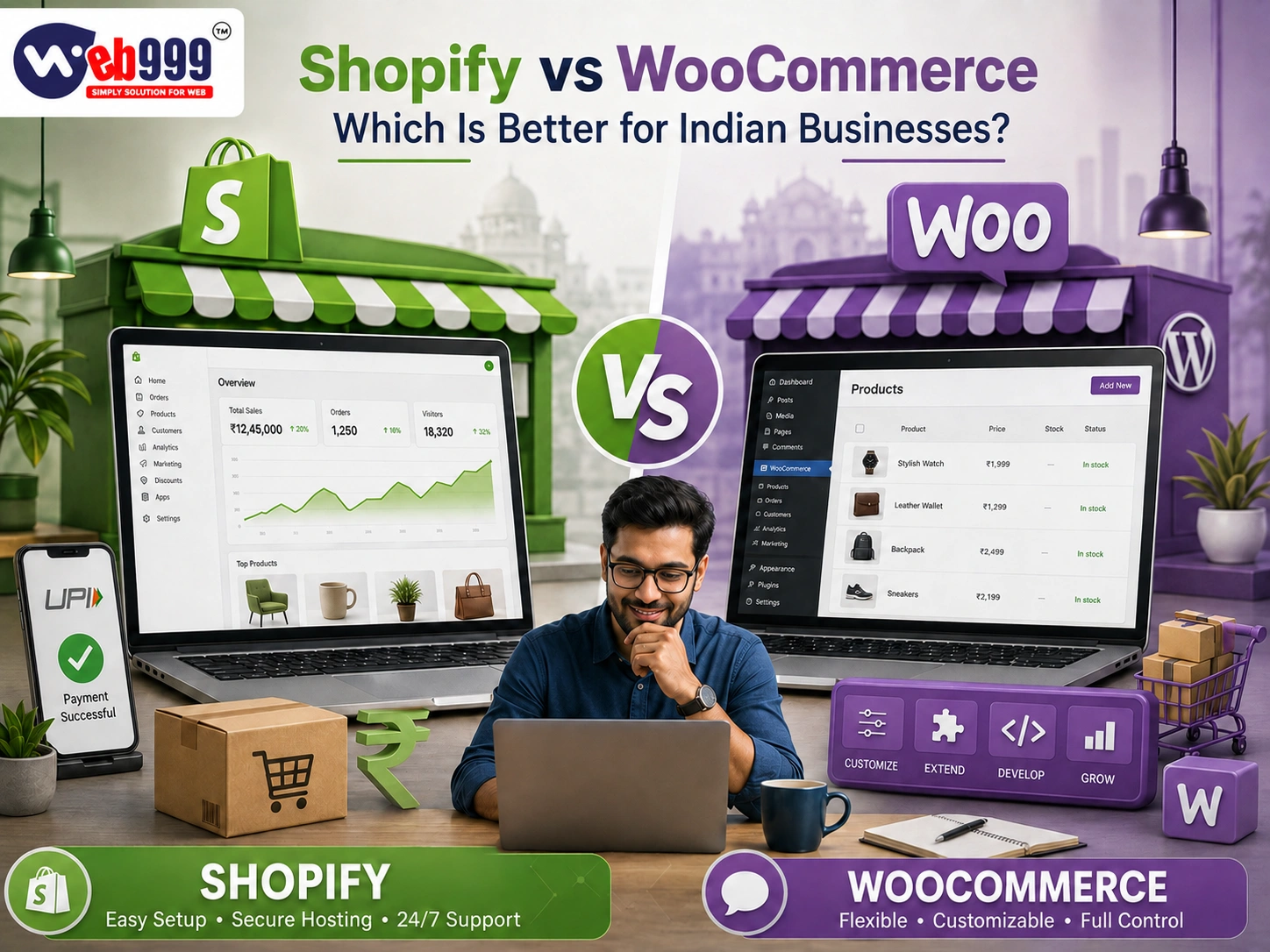
Choosing the right e-commerce platform is one of the most important decisions when starting an online business. The platform affects your website’s cost, design, performance, payment options, SEO capabilities and ability to grow.
Shopify and WooCommerce are two popular options for Indian businesses. Both can create professional online stores, but they work in different ways.
Shopify is a hosted e-commerce platform that includes hosting, security and store-management tools within a subscription. WooCommerce is a free, open-source WordPress plugin that gives businesses greater control over their website, hosting and functionality.
The better option depends on your budget, technical knowledge, product range and long-term plans.
What Is Shopify?
Shopify is a complete hosted e-commerce platform. It allows businesses to create and manage an online store without arranging separate website hosting.
Key Features of Shopify
It provides tools for:
- Adding and managing products
- Processing orders
- Tracking inventory
- Managing customers
- Creating discount codes
- Connecting payment gateways
- Viewing sales reports
- Customising the store’s design
- Selling through different channels
Shopify is suitable for business owners who want to start selling quickly without managing complex technical tasks.
What Is WooCommerce?
WooCommerce is an open-source e-commerce plugin developed for WordPress websites. The core software is free, but you need to arrange your own domain, hosting, security and website maintenance.
Key Features of WooCommerce
WooCommerce allows businesses to manage:
- Physical and digital products
- Product categories
- Customer accounts
- Orders and inventory
- Payment methods
- Shipping options
- Coupons and discounts
- Taxes and invoices
- Website content and blogs
WooCommerce is suitable for businesses that want greater control over their store’s design, features and SEO structure.
Shopify vs WooCommerce: Ease of Setup
Shopify is generally easier for beginners. Hosting, security and the main technical infrastructure are already managed within the platform.
A business owner can select a theme, upload products, configure payments and begin selling without setting up a separate server.
Setting Up a Shopify Store
Shopify reduces many of the technical steps involved in starting an e-commerce website.
What Shopify Manages for You
Shopify handles the main hosting and platform infrastructure, allowing the business owner to focus more on products, orders and customers.
Best for Quick Store Launches
This makes Shopify particularly useful for businesses that want to launch quickly without spending significant time managing technical infrastructure.
Setting Up a WooCommerce Store
WooCommerce requires more steps. You must purchase hosting, install WordPress, configure WooCommerce and manage the website’s technical settings.
It may require assistance from a developer, particularly when the store needs advanced features or a customised design.
Shopify is usually better for quick setup, while WooCommerce is better for businesses prepared to invest time in a customised solution.
Cost of Shopify for Indian Businesses
Shopify operates through monthly or annual subscription plans.
What Can Increase Shopify Costs?
The final cost may include:
- Shopify subscription
- Domain name
- Premium theme
- Paid applications
- Developer customisation
- Payment-gateway charges
- Third-party transaction fees
Some Shopify apps require separate monthly subscriptions. Installing several apps can significantly increase the store’s ongoing cost.
Businesses should check Shopify’s latest Indian pricing before choosing a plan because subscriptions and promotional offers may change.
Cost of WooCommerce for Indian Businesses
The WooCommerce core plugin is free, but running the store still involves expenses.
Common WooCommerce Costs
Common costs include:
- Domain registration
- Website hosting
- Premium theme
- Paid plugins
- Website development
- Security
- Backups
- Maintenance
- Payment-gateway charges
WooCommerce offers greater control over where money is spent. A small store can begin with essential features and add more functionality as the business grows.
However, complex customisation or poor-quality hosting can increase development and maintenance costs.
Design and Customisation: Shopify vs WooCommerce
Professional themes can be customised easily through Shopify's visual editor.
Shopify Design Options
You can modify:
- Colours
- Fonts
- Homepage sections
- Navigation
- Product displays
- Collection pages
- Promotional banners
Advanced changes may require knowledge of Shopify’s Liquid coding language. Some parts of the platform have customisation limitations.
WooCommerce Customisation Options
WooCommerce provides greater design flexibility because it works with WordPress. Developers can customise almost every part of the shopping experience.
Advanced WooCommerce Features
WooCommerce is suitable for features such as:
- Custom product layouts
- Product enquiry systems
- Wholesale pricing
- Customer-specific pricing
- Advanced product filters
- Custom checkout fields
- Membership websites
- Marketplace functionality
- Complex product variations
For simple and quick design, Shopify is convenient. For advanced customisation, WooCommerce is generally better.
Payment Options for Indian Businesses
Indian online stores commonly need:
- UPI
- Debit and credit cards
- Net banking
- Digital wallets
- Cash on delivery
- Bank transfer
- Buy Now, Pay Later
- International payments
Both Shopify and WooCommerce can connect with payment gateways available in India.
Shopify Payment Gateway Considerations
Shopify may charge an additional transaction fee when a third-party payment provider is used. This fee can be separate from the payment gateway’s own processing charge.
WooCommerce Payment Gateway Considerations
WooCommerce generally allows businesses to use compatible payment gateways without charging an additional platform transaction fee. The merchant still pays the selected gateway’s normal processing charges.
What Should You Check Before Selecting a Gateway?
Before selecting a platform, confirm whether your preferred gateway supports your required payment methods, refunds, subscriptions and international transactions.
Shopify vs WooCommerce SEO Capabilities
SEO helps e-commerce websites attract potential customers through Google.
Both platforms support SEO, but they provide different levels of control.
Shopify SEO Features
Shopify provides essential SEO features such as:
- Editable titles and descriptions
- Product URLs
- Image alternative text
- Automatic sitemap
- Mobile-friendly themes
- SSL security
- Redirect management
These features are sufficient for many small and medium-sized stores. However, there may be limitations in URL structure and advanced technical customisation.
WooCommerce SEO Features
WooCommerce benefits from WordPress’s content and SEO capabilities.
It provides greater control over:
- Product URLs
- Category structures
- Meta information
- Schema markup
- Blog content
- Landing pages
- Internal linking
- Redirects
- Technical SEO settings
Is WooCommerce Better for Content-Based SEO?
WooCommerce may be more suitable for businesses that depend heavily on blogging, content marketing and organic Google traffic.
SEO Results Depend on More Than the Platform
However, SEO results depend on implementation, content quality, website speed and competition—not only on the selected platform.
Website Speed and Performance
Shopify manages the hosting and server infrastructure. This makes it easier for business owners to maintain stable website performance.
However, a Shopify store can still become slow if it uses too many apps, oversized images or a poorly optimised theme.
What Affects WooCommerce Performance?
WooCommerce performance depends on:
- Hosting quality
- Theme quality
- Number of plugins
- Image optimisation
- Database condition
- Caching setup
- Developer expertise
A properly developed WooCommerce store can be fast and reliable. Poor hosting and unnecessary plugins can cause speed and security problems.
Shopify provides easier performance management, while WooCommerce provides more control over performance optimisation.
Security and Maintenance
Shopify manages server security, hosting maintenance and core platform updates. This reduces the technical responsibilities of the business owner.
Users are still responsible for protecting account passwords, managing staff access and installing trustworthy apps.
WooCommerce Security and Maintenance
With WooCommerce, the website owner or developer must manage:
- WordPress updates
- WooCommerce updates
- Plugin updates
- Theme updates
- SSL certificate
- Backups
- Malware protection
- Hosting security
- Compatibility testing
Can WooCommerce Be Secure?
WooCommerce can be secure when it is properly maintained. Ignoring updates or using unreliable plugins can create serious problems.
Shopify is easier for businesses that do not want to manage technical maintenance.
Shopify Apps vs WooCommerce Plugins
Both platforms allow businesses to add features through apps or plugins.
Shopify Apps
Shopify apps can provide:
- Product reviews
- Email marketing
- Shipping integration
- Dropshipping
- Subscriptions
- Loyalty programmes
- Customer support
- Invoice generation
- Product filters
- Marketplace connections
Many Shopify apps require monthly payments.
WooCommerce Plugins
WooCommerce plugins can provide:
- Indian payment gateways
- GST invoices
- Shipping integration
- Product enquiries
- Wholesale pricing
- Memberships
- Subscriptions
- Multi-vendor functionality
- Custom checkout fields
- Advanced product variations
Avoid Unnecessary Extensions
Both platforms have strong extension options. Businesses should avoid installing unnecessary apps or plugins because they can increase costs and affect performance.
Product and Inventory Management
Shopify and WooCommerce both allow businesses to manage products, stock levels, prices, variations and orders.
Inventory Management With Shopify
Both platforms allow businesses to manage products, stock levels, prices, variations and orders.
WooCommerce Inventory Management
WooCommerce offers more flexibility for stores with unusual requirements, including:
- Wholesale and retail pricing
- Customer-specific prices
- Measurement-based products
- Product enquiries instead of checkout
- Complex variations
- Custom product configurations
- Role-based product access
Shopify is easier for standard inventory management. WooCommerce is often better for complex product requirements.
Content Marketing and Blogging
Blogging is useful for attracting customers through Google, answering product questions and building brand authority.
Blogging With Shopify
Shopify includes basic blogging features that are sufficient for simple content marketing.
Blogging With WooCommerce
WooCommerce operates on WordPress, which offers more advanced blogging and content-management capabilities.
Businesses can create detailed blog categories, guides, landing pages and internal-linking structures.
Which Platform Is Better for Content Marketing?
WooCommerce may be the stronger choice when blog content and SEO are important parts of the marketing strategy.
Shopify vs WooCommerce Scalability
Both Shopify and WooCommerce can support growing businesses.
Scaling a Shopify Store
Shopify allows businesses to upgrade their subscription when they need more features. Hosting and technical infrastructure remain managed by Shopify.
The cost may increase through higher plans, paid apps, transaction fees and custom development.
Scaling a WooCommerce Store
WooCommerce can scale by upgrading hosting, improving server resources and optimising the website. It provides more flexibility but requires technical planning.
Requirements for Large WooCommerce Stores
Large WooCommerce stores need reliable hosting, regular maintenance and experienced development support.
Shopify offers easier scaling, while WooCommerce offers more control over how the website scales.
Customer Support
Shopify provides centralised platform support as part of its service. This can be helpful for beginners who want assistance with the store’s core system.
WooCommerce Support
WooCommerce support may be divided between:
- Hosting provider
- Theme developer
- Plugin developer
- Payment-gateway provider
- Website developer
A reliable development and maintenance partner can manage these services for WooCommerce businesses.
Shopify has a simpler support structure, while WooCommerce support depends more on the service providers selected.
When Is Shopify Better for Your Business?
Shopify may be the better choice if you:
- Want to launch your store quickly
- Have limited technical experience
- Prefer a managed platform
- Do not want to handle hosting
- Have a standard product catalogue
- Want centralised technical support
- Are comfortable with recurring subscription costs
Who Should Consider Shopify?
Shopify is particularly suitable for businesses that prioritise convenience, quick setup and managed technical infrastructure.
When Is WooCommerce Better for Your Business?
WooCommerce may be the better choice if you:
- Already have a WordPress website
- Want greater ownership and control
- Need advanced customisation
- Depend heavily on SEO and blogging
- Require B2B or wholesale features
- Want to choose your hosting provider
- Need complex product configurations
- Prefer flexible platform costs
Who Should Consider WooCommerce?
WooCommerce is particularly suitable for businesses that need greater flexibility, advanced customisation and control over their website.
Which Platform Is Better for Small Indian Businesses?
For a first-time seller who needs a simple online store and does not want to manage technical tasks, Shopify may be more convenient.
For a business that wants custom functionality, advanced SEO control and complete flexibility, WooCommerce may be a better long-term solution.
Consider the Complete Cost
Small businesses should consider the complete cost—not only the starting price.
Costs You Should Calculate
This includes:
- Subscriptions
- Hosting
- Applications
- Plugins
- Transaction charges
- Maintenance
- Developer support
Think Beyond the Initial Development Cost
A platform that appears cheaper during setup may not necessarily remain cheaper as your store grows. Consider ongoing expenses and the features your business may require in the future.
Common Mistakes to Avoid When Choosing an E-Commerce Platform
Businesses should avoid:
- Selecting a platform only because it looks cheaper
- Ignoring payment-gateway charges
- Forgetting recurring app or plugin costs
- Using a slow or poorly designed theme
- Installing unnecessary extensions
- Ignoring mobile users
- Publishing incomplete product information
- Starting without shipping and return policies
- Not planning website security
- Choosing low-quality WooCommerce hosting
- Building a store without an SEO strategy
- Creating a complicated checkout process
Plan Before Starting Development
Prepare a list of required features and expected costs before starting development.
Final Verdict: Shopify or WooCommerce?
There is no single platform that is best for every Indian business.
Choose Shopify if you need a simple, managed and quick-to-launch online store. It is suitable for business owners who prefer convenience and do not want to manage hosting or regular technical maintenance.
Choose WooCommerce if you require greater control, deeper customisation and stronger content-management capabilities. It is particularly suitable for businesses that need specialised features, B2B functionality or an advanced SEO strategy.
Which One Should You Choose?
The correct platform is the one that matches your products, budget, team and long-term business goals.
Choose Shopify for Convenience
Shopify makes sense when ease of use, managed hosting and quick setup are your main priorities.
Choose WooCommerce for Flexibility
WooCommerce makes sense when customisation, ownership, SEO control and specialised functionality are more important.
How Web999 Can Help
Web999 develops responsive and SEO-friendly e-commerce websites for Indian businesses.
E-Commerce Development Services
Services can include:
- Shopify store development
- WooCommerce website development
- Custom e-commerce design
- Product and category setup
- Payment-gateway integration
- Shipping configuration
- Mobile optimisation
- Technical SEO
- Website speed optimisation
- Store migration
- Maintenance and digital marketing support
Choosing the Right Platform With Web999
Web999 can understand your requirements and recommend the most suitable platform for your business.
Get Professional E-Commerce Consultation
If you are unsure which platform matches your requirements, professional consultation can help evaluate your products, functionality, payment requirements, SEO goals and long-term plans.
Contact Web999
Call: +91 99044 34226
Website: www.web999.in
Conclusion
Shopify provides convenience, managed hosting and an easier setup process. WooCommerce provides flexibility, customisation and greater control over the website.
Your decision should not be based only on popularity. Consider your products, budget, expected sales, payment requirements, SEO goals and available technical support.
Need help choosing between Shopify and WooCommerce?
Contact Web999 for professional e-commerce website development and consultation.
Call: +91 99044 34226
Website: www.web999.in